


Proof that SOME rich have a larger slice of the pie than they deserve
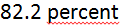
In the United States, the richest 1% account for 24% of the nation's income—but do they do a quarter of the work?
Far from it.
Do they generate a quarter of the great ideas?
 “Power doesn't corrupt; it reveals.”
Are today's superrich any different? Human nature hasn't fundamentally changed. Enough is usually never enough. More power, more money, or more sex with more beautiful women. Henry Kissinger said, “Power is the ultimate aphrodisiac.”
Ghosts of Manhattan describes how high rollers on Wall Street use booze, drugs, and high-priced hookers to fuel risky lifestyles and risky deals that partly satisfy their primal urges for risky behavior (that American taxpayers, consumers, and investors pay for, BTW). It's a novel based on fact, as evidenced by the revelations of Kristin Davis, the “Manhattan Madam.”
In the age of incurable sexually transmitted diseases (not all of which are prevented by condoms, as if they're always used), one must wonder why men engage in such risky behavior. Speaking as a doctor, it's because they have a screw loose. To put it in shirtsleeve language, they are nuts who are self-medicating themselves. Hypersexuality is just one manifestation of their mental pathology.
As my medical school professors stressed, and as I discussed in The Science of Sex, sex is the primary glue that binds men and women together. Making sex much better (the object of my book) builds stronger and happier marriages. That is better for everyone involved, including children and society.
If the food you eat at home or in restaurants is disappointing and leaves you wanting something better, you're bound to seek new ways to have more pleasure. The same is true in sex: disappointment fuels exploration, which often leads to affairs and divorce (and unhappy kids), when people don't know enough about sex to obtain sufficient pleasure with their current partner.
Thinking “the grass is always greener on the other side of the fence,” people assume that a new partner may be their only way to obtain full gratification. They assume that sex is simple and that they've done everything possible to improve it, so they frequently conclude it isn't what they're doing, it is who they're doing it with. Hello affairs, goodbye marriage.
However, as my book makes clear, sex may seem simple, but to optimize libido, performance, and pleasure, you need to know a surprising amount of science (hence the title of my book) that goes beyond what most doctors know. We study hot SEX (not just the cold biology of reproduction) in medical school, but med school is just Intro to Everything Medical; we were repeatedly told to continually build upon those foundations throughout our professional careers. About everything except sex? No, that too. It's a very important part of life.
Thus I am certainly not against sex in long-term relationships, but what they do on Wall Street—such as using corporate credit cards to pay for prostitutes who charge $2000 per hour—is just plain crazy, in more ways than one. Now that American taxpayers are paying off debts incurred by Wall Street firms, Main Street folks are paying for overpriced prostitutes.
An interesting article explains why powerful people often behave so badly and why they can't control themselves. The fact that some (not all) of the richest 0.1% in the world are screwing it up for the other 99.9% suggests that if we want a better and fairer world, we must take power from the most powerful; we can't expect our leaders (Democrat or Republican) to do it; they're both in bed with the ultra-wealthy fat cats who pull their strings.
But if you're thinking revolution and bloodshed, think again. Even high school dropouts with common sense should be able to think of how we could improve the world legally and ethically. However, not many people think for themselves; they just play back the thoughts of others.
Incidentally, business isn't always about maximizing money and power; the #1 goal of some businessmen is to boost their egos (example). This reduces our national prosperity and gives consumers products that aren't the best possible. Why don't the corporations producing them go out of business? Because their competitors make suboptimal products, too.
The answer is a resounding no, as I discussed in an article on wealth inequality. Some rich folks deserve every penny of what they have, but most are the beneficiaries of luck or took a larger slice of the pie than they deserve by using crafty evasions of laws and ethics.
Luck is rarely the sole factor behind wealth, but it often plays a significant role in determining who is merely successful versus who is über-rich.
Want proof? Consider this simple thought experiment. Let's say that God is having second thoughts about how the economic pie is divided, so he levels the playing field, equally distributing the wealth. To compensate the ones he took money from, he doubles the earnings of the winners of this game if they were previously rich. Thus, when the dust settled years later, some people would be poor, and some would be rich, but the ones originally wealthy would be given a bonus by God for coming out ahead after he pressed an economic reset button designed to test whether wealth was equitably distributed.
I would jump at the chance to play this game, but how many rich people would? Not many, because—despite their often overblown egos—deep down, they know they have much more than they deserve. If Bill Hates were to participate in that economic reset game, what is the chance he would be the world's richest man?
Zero. Judging by his exasperating software replete with glaring errors evident to everyone with common sense and at least a room-temperature IQ, Hates isn't even smart enough to hire people who can point out the obvious flaws in his products. For Microsoft to prevail over other software companies is as logical as an ugly duckling winning a beauty contest.
Even Hates is incensed by the junk they sell that makes people want to scream (see Bill Hates On Microsoft: Damn, Our Usability Sucks based on his epic rant that was verified as authentic). One reason why even very smart people have so many problems using Microsoft's garbage is that smart people think logically, but logic and high IQs are no match for shoddy, scatterbrained products thrown together by people who either don't care what they are doing or are so bereft of common sense they can't see what they are doing wrong. A reporter who spoke to Hates about his rant said he “didn't seem to understand why the message would be news to people.”
Hates didn't understand that? What planet is he on? Like many rich people, Hates uses his money to insulate himself from people who live in the real world, including his customers, whose lives are often beset with the myriad goofy problems that Microsoft is adept at generating.
I've had patients in the ER upset and even depressed after dealing with Microsoft problems that would drive almost anyone bonkers. One man shot his computer. Microsoft's ineptitude provoked a computer magazine columnist to say that he'd like to lob some grenades toward Redmond, Washington (home of Microsoft).
In a Forbes article (Dim Vista), Stephen Manes wrote, “Vista is at best mildly annoying and at worst makes you want to rush to Redmond, Wash. and rip somebody's liver out.” He cut to the heart of the problem by saying, “If I can find plenty of problems in a matter of hours, why can't Microsoft? Most likely answer: It did—and it doesn't care.” Microsoft would rather torment its users than bother to fix them; Microsoft has better things to do. If it's half-assed, poorly conceived, and poorly implemented, Microsoft thinks it is good enough for its customers. Let 'em go pound sand or rip their hair out!
One of my brilliant customers has a father with a stratospheric IQ who was one of the pioneers of the computer industry, yet even he has been so frustrated by Microsoft products that he fantasized about visiting their campus and doing them bodily harm.
“Unfortunately, people are not rebelling against Microsoft. They don't know any better.”
— Steve Jobs
“I am saddened, not by Microsoft's success — I have no problem with their success. They've earned their success, for the most part. I have a problem with the fact that they just make really third-rate products.”
— Steve Jobs
“The only problem with Microsoft is they just have no taste. They have absolutely no taste. And I don't mean that in a small way, I mean that in a big way, in the sense that they don't think of original ideas, and they don't bring much culture into their products.”
— Steve Jobs
“I wish developing great products was as easy as writing a check. If that was the case, Microsoft would have great products.”
— Steve Jobs
“Our friends up north [Microsoft] spend over five billion dollars on research and development and all they seem to do is copy Google and Apple.”
— Steve Jobs
“I wish him [Bill Gates] the best, I really do. I just think he and Microsoft are a bit narrow. He'd be a broader guy if he had dropped acid once or gone off to an ashram when he was younger.”
— Steve Jobs
“Because Gates rather than the more innovative Kildall prevailed, according to the book, the world's PC users endured "more than a decade of crashes with incalculable economic cost in lost data and lost opportunities."”
— Excerpt from The Man Who Could Have Been Bill Gates, which suggests that Microsoft's early success resulted from them stealing essential elements of an operating system (also see Did Bill Gates Steal the Heart of DOS?, noting the author's connection to Microsoft)
I lost a fiancée because of Microsoft. The plan was for me to complete a book I was writing in about two weeks, then join her in Maine so we could get married. Thanks to endless computer crashes, that two weeks stretched into six months—too long. It's too bad I wasn't still using my Atari 520 ST computer, which never crashed in all the years I used it. I heard of computer crashes at that time and wondered what they were; Microsoft gave me a good education in that. There's an obvious (to me) way to undo computer crashes so users don't lose data, need to reboot, or pull their hair out, but Microsoft evidently hasn't thought of that.
That's not surprising. Manes added:
“I suggested to one Windows product manager that if the company were truly serious about security, Vista might offer a simple way to delete files securely and eliminate all traces of identity and passwords so you could safely pass the machine on or sell it years from now. His reply: "Does any other operating system do that?" That tells you all you need to know about Microsoft. The real slogan: "No innovation here."”
After Microsoft bragged that using Vista may leave you speechless, searching for words, a writer said au contraire by writing:
“Er, yes... searching for words, and finding them. After the initial shocked silence, Vista users (and refusers) are anything but speechless. They're speaking loudly, and speaking lots. Saying far more than Microsoft would like them to. Saying things to make even a Ballmer cringe [he is a Microsoft big shot with a volcanic temper who inspired the book, Bad Boy Ballmer]. Vista has struck them downright loquacious. In fact, Vista users are rediscovering words they thought Mom had washed out with that bar of Ivory so long ago.”
Source: Anything but Speechless: 100 Things People Are Really Saying About Windows Vista
Comment: One reason is that Microsoft routinely releases poorly conceived, poorly implemented products that waste users' time and cause endless headaches.
Some people claim that Hates is always the smartest person in the room, but that is a reflection of the human tendency to flatter rich people by sycophantically magnifying their assets and minimizing their flaws. Hates wasn't even close to being the smartest or most creative person at Microsoft. Had it been led as an intellectual meritocracy, it could have produced much better software, and when my Mom purchased a computer to communicate with her grandchildren via e-mail, she could have spent more time doing that than trying to solve the endless stumbling blocks that Microsoft gives to its customers.
“If you can't make it good, at least make it look good.”
— Bill Gates
“Unfortunately, people are not rebelling against Microsoft. They don't know any better.”
— Steve Jobs
Microsoft is so pathetically inept at fixing problems they haven't yet fixed the ancient CTRL+C bug, in which simultaneously pressing those keys should always copy the selected item to the clipboard, but doesn't sometimes. It's happened to me thousands of times on every Windows computer I owned, including when I carefully observed the keys pressed and replaced the keyboard once or twice. If Hates is such a genius, why can't he fix that problem?
“Microsoft … has too many smart people whose talent is being wasted.”
Comment: Guess why?
Leonard Mlodinow, author of The Drunkard's Walk: How Randomness Rules Our Lives, wrote a fascinating and provocative article entitled The Meritocracy Paradox for Forbes magazine that discussed how hotshot CEOs are often just the beneficiaries of luck, not everlasting talent. Hates was the beneficiary of luck, being in the right place at the right time. If he were to start now, having no foot in the door, he would be laughed out of business.
Hates owes his success primarily to incredible luck, not talent. He was born into a wealthy family that gave him pivotal advantages, such as “his mother's social connection with IBM's chairman [that] enabled him to gain a contract from the then leading PC company, generating a lock-in effect that was crucial for establishing the software empire.”
Hates deserves his billions as much as President Obama deserves his Peace Prize (Obama's lack of dovishness prompted many of his former supporters to brand him as Bush III), or as much as Teresa Heinz deserves her fortune. What did she do to deserve it? Be lucky enough to be attractive enough to marry Henry John Heinz III, an heir to the Heinz family fortune.
Teresa's husband “earned” his fortune by sliding down the right birth canal, but despite his privileged Ivy League education, he didn't have enough common sense or concern for others to keep his Piper Aerostar from colliding with a helicopter over an elementary school, killing two first-grade girls, critically burning a boy, injuring “the school custodian and an unknown number of other bystanders.” Heinz was a licensed pilot in a small twin-engine plane, so he should have insisted that the pilot follow standard protocol. As The New York Times noted, when planes report problems with their landing gear, “a more common procedure [ … is] to fly low over the airport so that observers on the ground can look at its undercarriage.” They added that “even with the landing gear up, it is possible to land a small plane on its belly without severe risk to occupants.” Of course, when you're rich and famous, you can bend the rules, but not the laws of physics.
I've seen rich people in the hospital acting as if their wealth gave them the right to special treatment. In their minds, it was perfectly acceptable to insist that others who weren't rich and well-connected should wait so they could be treated like royalty. Believe it or not, but the hospital brass actively participated in the care of VIPs. Even in the frigging middle of the night on a weekend, if a VIP was coming in by car or ambulance, a big shot hospital administrator would call me and usually show up before the VIP hit the ER door. The message was clear: This person deserves special treatment. The crying kids? The people with kidney stones? The patients with heart attacks, strokes, seizures, and diabetic coma? They can wait.
I could fill a series of thick books describing people like Teresa Heinz and her husband who have far more than they deserve. Would they voluntarily participate in God's economic reset game? Never in a million years.
Is all of this a moot point? Not really. Understanding it is key to understanding why the world has so many problems that persist indefinitely. Most of the wealth and power is disproportionately held by those who aren't the smartest, most creative, hardest working, or most caring. Instead, money and power are concentrated in people who are often the beneficiaries of luck. They know it, and they'll be damned if they will permit changes that make the world more of a meritocracy and less of a lottery of luck.
I did something that Bill Hates, Teresa Heinz, or Henry John Heinz III did not do: earn a doctorate degree, which only 1% of U.S. adults possess. I graduated in the top 1% of my class in medical school, which had nothing to do with luck. Give me an exam (some 1000 questions long) filled with questions that would make an average person's head spin, or give me a patient screaming in pain or gasping for breath, or give me an x-ray or EKG to read, and I can consistently perform two standard deviations above the level of average doctors.
However, I wasn't born smart. My sixth-grade teacher was so exasperated by my stupidity that he called me “slow” in front of the class. I had to work hard for many years to ascend the bell curve of intelligence. By the time I completed my training, but before I earned a single dollar as an attending physician, I'd already worked more hours than most people do in their entire lives.
Few people realize how many hours it takes to go from being a high school graduate to a licensed physician, and how many more it took me to go from a dunce to being elected to membership in Alpha Omega Alpha (AΩA). AΩA “is to medicine what Phi Beta Kappa is to letters and the humanities and Sigma Xi is to science.” AΩA members include dozens of Nobel Prize winners in Physiology or Medicine and almost 75% of U.S. medical school deans.

The fact that I went from dunce to doctor (after serendipitously discovering how to augment IQ and creativity) made me a fan of meritocracies. Call me biased if you will, but I think people who work as hard as I did (and do) should be rewarded and have more, which incentivizes others to work hard and make sacrifices. In retrospect, some of the things I gave up, such as time with family and friends, and even special occasions with them (weddings, Thanksgiving, Christmas, family reunions, etc.), were priceless. However, my medical career and the sacrifices I made for it are just a fraction of the overall ones I've made in pursuit of success and my dream of helping others. What did I do my last Thanksgiving, Christmas Eve, Christmas Day, New Year's Eve, and New Year's Day? I worked all of them, about 16 hours per day, getting paid for generating ideas. Like most dream jobs, it's not as easy as it seems.
Many people are smarter than I am and work just as hard, but they couldn't begin to do what I do because they let themselves be molded by a world that champions inside-the-box thinking as the perfect way to keep sheeple from daring to suggest changes designed to address pressing problems. In my opinion, most of the über-rich care less about solving those problems than staying on top of the pile, even if those at the bottom are crushed by them.
Nathan Myhrvold, one of the true geniuses at Microsoft, remarked that a friend of his said that “you can’t do anything new in the world without being misunderstood.” True. History abounds with examples of how brilliant innovators were scorned and ridiculed. For all the lip service we give to valuing new ideas and those who generate them, we're often allergic to the former and eager to lambaste the latter, preferring to reserve our adulation for cute dysfunctional celebrities and professional athletes skilled at playing children's games.
Now you know why the world is less successful and less peaceful than it could be: what should have been a meritocracy became a luckocracy: a system in which advancement is based not on individual achievement, but too often on luck. By itself, luck has a tenuous ability to ensure continued success, which is why the beneficiaries of luck dare not risk significant change.
“This country wasn't built by men in suits, but it sure is being destroyed by them.”
— Unknown
“More people have been robbed with a briefcase than have ever been robbed with a gun.”
“Our society is run by insane people for insane objectives. I think we're being run by maniacs for maniacal ends and I think I'm liable to be put away as insane for expressing that. That's what's insane about it.”
— John Lennon
“In societies with strong power elites, the powerholders' power is dependent on the co-operation, acquiescence, and tacit support of the great majority of common citizens.”
— Bill Moyer
[Steve Jobs] “always believed that the rules that applied to ordinary people didn't apply to him.”
— Walter Isaacson, author of the biography Steve Jobs
Related articles
Bloody hands and wealth inequality
Notes:
- 'Lower status' people more likely to share wealth than 'higher status' people: 'Lower status' people more likely to share wealth than 'higher status' people
- Expectations can minimize unethical behavior in the powerful: Focusing the powerful to think about how they should behave may serve as a potential form of 'preventative medicine' against the abuse of power
- Why people cheat
Excerpt: “A 2011 study found, rather unambiguously, that rich people are more likely to "take valued goods from others," "lie in a negotiation," "cheat to increase their chances of winning a prize," and "endorse unethical behavior at work."” - World Leaders Hid Wealth Via Shell Companies, Report Alleges
- Higher social class predicts increased unethical behavior
- KRUGMAN: It's Not Just About Hard Work — Dumb Rich Kids Get All The Breaks
- Risk-takers are smarter, according to a new study
- This is what rich people know about money that you don't
- Hedge-fund billionaire says inequality could be 'disastrous'
Excerpt: “'Now here's a macro forecast that's easy to make, and that's that the gap between the wealthiest and the poorest, it will get closed. History always does it. It typically happens in one of three ways—either through revolution, higher taxes or wars.'” - “[Too many Wall Streeters] work gaming ratings companies, and designing securities to fail so they might make a killing off the investors they dupe into buying them, and rigging various markets at the expense of the wider society, and encouraging all sorts of people to do stuff with their capital and their companies that they never should do.” (excerpted from Occupational Hazards of Working on Wall Street)
- Excerpt from BillMoyers.com: “Our system … isn't truly competitive the way a capitalist system should be — it has, in fact, been engineered by the wealthy to prevent competition and to protect their economic and political power.”
- Banned TED Talk: Nick Hanauer "Rich people don't create jobs"
Comment: Perhaps true, but chicken or egg “which came first?” problem: without corporations producing goods and services, consumers have no opportunity to create demand for them. In some cases, forward-thinking CEOs produce stuff before others know it exists or realize they want it, thereby creating a new industry or product.
• Banned TEDtalk controversy
• Nick Hanauer's civic activism - How Wall Street Banks Cheat Their Clients
- Microsoft’s battle with IRS heats up as Ballmer, other execs refuse to testify
Comment: Hmm, that's odd: a very rich Microsoft billionaire advocates higher taxes—yet Microsoft plays such games? - Nobel Prize-Winning Economist: We're Headed for Oligarchy
Robert Solow on powerful families' threat to democratic institutions - Number of billionaires doubles since financial crisis
- 'Drink Less, Work More', Billionaire Tells Non-Rich
Excerpt: (advice she gave) “There is no monopoly on becoming a millionaire. If you're jealous of those with more money, don't just sit there and complain. Do something to make more money yourself—spend less time drinking, or smoking and socializing and more time working.”
Comment: That isn't bad advice, but judging by the negative and even incandescent reaction it elicited, many people vehemently disagree with her. I don't. In fact, I'd go further and advise people to pull the plug on the Boob tube (TV) along with their computers and cell phones.
Americans reportedly spend an average of 23 hours per week online and texting. The addiction appears to be exacerbating (see Media Consumption To Average 15.5 Hours A Day By 2015). For most people, the Internet and media are the greatest time drains ever invented. Now that we've identified the problem, the solution is obvious: stop using electronic devices that mesmerize us but do little for us. I've used the Internet productively to access many thousands of scientific papers pertinent to my work as a doctor and inventor, but most Internet users have nothing tangible to show for their lavish time investment. Yes, we all need fun—but that much?
Now pardon me as I go back to work on this Labor Day—how appropriate, huh? (This blogging is just a break to give my overworked mind a little R&R to help recharge its batteries. I also write to expand my brainpower, as I will discuss in an upcoming article. Few people receive a commensurate benefit because few people write like I do. Pity.) - Crying Wolf: Who Benefits and When?
Excerpt: “ … higher-ranking group members [have] the most to gain by perceived threats to the group.”
Comment: The ruling class has myriad ways to frighten others to get their way. Name some of the more obvious ones. - Movie: Robert Reich's Inequality for All
- The trillion-dollar lesson we'd rather not learn again
Excerpt: “We've gotten hold of a secret that was previously only fully understood by Beltway insiders: the extent to which mega-bank executives control the outcomes we receive from government officials.” - Book by Charles Gasparino: Circle of Friends: The Massive Federal Crackdown on Insider Trading---and Why the Markets Always Work Against the Little Guy
- The Rich Get Richer Through the Recovery
Excerpt: “The top 10 percent of earners took more than half of the country’s total income in 2012, the highest level recorded since the government began collecting the relevant data a century ago …” - Income Gap Blows Out: Rich Get Richer
Excerpt: “ … the top 1 percent captured 95 percent of the income gains during the three-year recovery.” - In 2008, Rep. Brad Sherman (D-CA) said some Congressmen were threatened that martial law would be imposed if they didn't vote for the $700 billion banker bailout (TARP).
- Six Charts That Prove The Tax Code Was Written For The Rich
Excerpt: “[According to] the Congressional Budget Office, … the U.S. tax code is designed to turn the screws on the middle class, while granting huge tax breaks to the rich and and tax credits to the lowest income quintile.” - The Detroit 'Bail-In' Template: Fleecing Pensioners to Save the Banks
- American Colleges Rob Poor Students, Pay the Rich
- Wealth concentration
- Mother Jones: It's the Inequality, Stupid
- State of Working America preview: The rich get richer
- Michael Kinsley in the LA Times: The wealth gap
- Saul Friedman: Consequences of Unequal Distribution of Wealth: The Rich Get Richer …
- Pew Research Center: A Rise in Wealth for the Wealthy; Declines for the Lower 93%: An Uneven Recovery, 2009-2011
Comment: That is exactly what I predicted in From Bailout to Bliss. - Richer Rich, and Poorer Poor
- Why it is hard to share the wealth
- Report Exposes Secrets of Off-Shore Tax Havens
Excerpt: “The off-shore tax havens of least 30 Americans accused of fraud, money laundering or other financial crimes … [could total] … as high as $32 trillion. That's roughly the size of the U.S. and Japanese economies combined.” - Secret Files Expose Offshore’s Global Impact
Excerpt: “A cache of 2.5 million files has cracked open the secrets of more than 120,000 offshore companies and trusts, exposing hidden dealings of politicians, con men and the mega-rich the world over.” - Henry Blodget: It's Time To Focus On Creating Value, Not Profit
- Plutocrats: The Rise of the New Global Super-Rich and the Fall of Everyone Else
- 'Econophysics' Points Way to Fair Salaries in Free Market
Excerpt: “The self-correcting free market mechanisms have broken down for CEOs and other top executives in the market, but they seem to be working fine for the remaining 95 percent of employees. … The researcher has determined that fairness is integral to a normally functioning free market economy.” - New Theory On Fairness In Economics Targets CEO Pay
- Netflix CEO Reed Hastings “seemed to lack an empathy gene” that “makes it difficult for him to anticipate how Netflix subscribers will react.” Esther Dyson, a longtime friend of Bill Hates, said he “never really grew up in terms of social responsibility and relationships with other people. He's brilliant but still childlike. He can be a fun companion, but he can lack human empathy.”
That might explain why he doesn't understand why exasperated customers are so annoyed with Microsoft's software and laggard pace of fixing obvious problems that should have never occurred or been fixed long ago. Hates reportedly instituted a Microsoft culture that rewarded pure brilliance even if it was housed in minds bereft of empathy that couldn't fully understand customers and hence couldn't fully profit from them. Consequently, Microsoft's success, although impressive, could have been even greater.
Hates is avidly interested in education, but he evidently doesn't know that empathy can be easily enhanced—within seconds, in fact. More advanced methods can produce more impressive results, even in people with Asperger's syndrome. I discussed that in one of my ER sites in response to a question from a medical student contemplating his specialty choice. - Everything that’s wrong with Microsoft, as told by veterans who abandoned the company
- 5-Year Old Kid Finds A Security Exploit On The Xbox One, Gets A Researcher Credit
Comment: Even young kids can spot Microsoft flaws! - Wealthy Stash $21 – $32 Trillion in 'Pirate' Banks
Excerpt: “The $21 trillion to $32 trillion estimate does not include real estate, yachts, thoroughbreds or gold bricks.” - Jailed Banker Who Helped Crack UBS Gets $104 Million Payout
Excerpt: He revealed “the inner workings of the secretive private wealth management division of the Swiss bank UBS … where [he] helped his [rich, no doubt] US clients evade taxes by hiding wealth overseas.” - Revealed – the capitalist network that runs the world
- Reward the Second Best, Ignore the Best based on Top performers are not the most impressive when extreme performance indicates unreliability
- The Self-Made Myth: And the Truth about How Government Helps Individuals and Businesses Succeed
- Golden Parachutes: 21 CEOs Landed $100M Plus
- Example of an overly golden parachute: Yahoo's “De Castro was let go after a little over a year on the job, with ad sales as dreadful as ever. … his generous severance … turned out to be nearly $58 million, including $16 million in performance bonuses that, were I a shareholder, I'd have a hard time to swallow. (De Castro refused to confirm figures – he's under quite the stringent NDA … but said his kind of pay is "normal:" "These are jobs that pay well because there's a high risk." By this token, nuclear plant workers and firefighters should be billionaires.)” [source]
- The rich are getting richer and the middle class are getting poorer
- At 102%, His Tax Rate Takes the Cake
- How the world's wealth is distributed—the top 2% own half
- Zuckerberg's 1.05% mortgage
- How to Become As Rich As Bill Gates
- Microsoft: Leave Us, But Don’t Mock Us
Comment: Paying him a fortune to keep quiet? What's Microsoft hiding? - “Why I hate Microsoft”
- Why Do People Hate Microsoft?
- Why Microsoft SUCKS! Confessions From an Ex-Employee
- Windows 8 is "Terrible," Says Usability Expert Jakob Nielsen
Comment: A glaring lack of common sense explains how they could spend a boatload of money developing a new operating system that's worse, not better. - The Warren Buffett Haters Club A common theme explains this sentiment: Buffett complains that the rich aren't paying their fair share of taxes, but his own company, Berkshire Hathaway, has been mired in a protracted legal battle with the IRS over unpaid taxes that may total $1 billion. Buffett could do his part to pay more, but he instead chose to fight tooth and nail to NOT pay what the IRS says is due. This is one of the most egregious examples of hypocrisy ever. Buffett's smug little smile manifests how much he enjoys the overly positive press he receives from reporters either paid for their image propaganda or too stupid to realize the wool is being pulled over their eyes.
I won't equate Buffett with Hitler, Stalin, Chairman Mao, or Emperor Hirohito, but it is important to note that those four blood-thirsty barbarians received good press in their time, too. Hirohito still is depicted as a peace-loving man even though he was the second-greatest butcher in history who sent his men to pillage other countries and commit crimes against humanity that included gang rapes of elderly women and infants followed by sexual mutilations such as spearing their vaginas. - Moguls Rent South Dakota Addresses to Dodge Taxes Forever
- The Rich Are Less Charitable Than the Middle Class: Study
- Lower Classes Quicker to Show Compassion in the Face of Suffering based on Class and compassion: Socioeconomic factors predict responses to suffering
- Upper Class People More Likely to Behave Unethically based on Higher social class predicts increased unethical behavior
- Red Bull heir suspected in deadly hit-and-run and then there was John Goodman, heir to the vast Goodman fortune, who was “sentenced to 16 years in prison for killing [a] promising student in drunken hit-and-run.” See a pattern developing here? But wait, it gets even stranger. Evidently trying to shield some of his assets, Goodman “adopted his 42-year-old girlfriend,” making her “entitled to up to a third of his biological children's $300 million trust fund.”
- Affluent People Less Likely to Reach out to Others in Times of Trouble? based on Class, Chaos, and the Construction of Community
Comment: The Milburn Drysdale effect. - The More Secure You Feel, the Less You Value Your Stuff based on Heightened interpersonal security diminishes the monetary value of possessions
- Materialistic People Liked Less by Peers Than 'Experiential' People based on Stigmatizing Materialism: On Stereotypes and Impressions of Materialistic and Experiential Pursuits
- Upper-Class People Have Trouble Recognizing Others' Emotions based on Social Class, Contextualism, and Empathic Accuracy
- Are Power And Compassion Mutually Exclusive? The authors noted that this study “suggests that high-power individuals may suffer in interpersonal relationships because of their diminished capacity for compassion and empathy. The many benefits enjoyed by people with power may not translate to the interpersonal realm.”
- Rich Man, Poor Man: Body Language Can Indicate Socioeconomic Status, Study Shows based on Signs of Socioeconomic Status: A Thin-Slicing Approach
- 21 Ways Rich People Think Differently
- Market Exchange Rules Responsible for Wealth Concentration, Physicists Say based on Entropy and equilibrium state of free market models
Excerpt from first link: “To study free market models, the authors used statistical mechanics methods focusing on the dynamic of wealth exchange over time. These methods were inspired by Boltzmann's theory of kinetic energy exchange between gas molecules during collisions. They found that over time, all the available wealth is concentrated among only a few agents.” - Ex-Stock Broker: I Realized That Most Of What I Did Was Bad For Clients–So I Quit
Comment: This meshes with other evidence that the big Wall Street firms prey on unsuspecting investors. - Why I Am Leaving Goldman Sachs by Goldman Sachs executive director Greg Smith
- Is Goldman Sachs in the Business of Ripping Off Clients? (the answer seems to be YES)
- Departing Goldman banker slams 'rip-off' culture
- Exec: Goldman officials called clients 'muppets'
- Business culture in banking industry favors dishonest behavior
- The rich can stop worrying about a middle-class revolution
- Billions in Hidden Riches for Family of Chinese Leader
Comment: American politicians often exploit their political power to become rich using a variety of tactics—some legal, many questionable. Example: Why Hillary Clinton should not become Secretary of State. - Forcing the Rich to Bail Out Europe
- UK Recession May Be to Blame for Over 1,000 Suicides in England
Comment: The rich get richer, and the others get a grave. - 10 awe-inspiring American castles
- Meet the Largest Landowner in America: The media billionaire John Malone now owns 2.2 million acres, putting him ahead of his pal Ted Turner as the nation's No. 1 landlord.
- The Man With a Million Acres
Comment: According to the article, the billionaire “made his fortune in the discount cigarette business.” That's legal, but if money were distributed fairly or even halfway fairly (something our system does not do), he would not have become so fabulously wealthy from cigarettes that help people destroy their health, appearance, and mood. I know a man who became rich by selling old junk food—just what America doesn't need. - Almost 2,400 U.S. Millionaires Pocketed Jobless Benefits
- Biofuels Benefit Billionaires (but not us)
- Meet the Wealthiest Person in Each State
- Over-the-top home features of the 1%
- Billionaire security: ultimate protection measures
- There Are At Least 9 Senior Executives At JCPenney Who Commute By Jet
- Ukraine's new first lady a breath of fresh air
Excerpt: “ … Ukraine's new first lady Marina Poroshenko looks set to usher in a new age, dispensing with the stuffy arrogance long associated with the country's political elite.”
Comment: And some rich people. - The Hong Kong Leader's Daughter Bragged About Her Fabulous Taxpayer-Funded Life On Social Media
- Need an Intern With a Strong Sense of Entitlement and Bad Manners? Hire a Rich Kid
- Corporate greed: That gut feeling you have about your CEO is spot on
- Powerful people are quick to notice injustice when they are victimized, research finds
Excerpt: “Power is accompanied by a sense of entitlement, which shapes reactions to self-relevant injustices. Researchers … found that the powerless are comparatively less sensitive to unfair treatment, suggesting a process by which hierarchies may be maintained: the powerful retain their social standing by quickly perceiving and responding to self-relevant injustices.” - Exposing The World Of The One Percent
- Paradise Papers
Excerpt: “The Paradise Papers is a set of 13.4 million confidential electronic documents relating to offshore investment that were leaked to a German newspaper and released on 5 November 2017 into the public domain. … According to the Boston Consulting Group, the amount of money involved is around $10 trillion.” - List of people and companies named in the Paradise Papers
“The test of a first-rate intelligence is the ability to hold two opposed ideas in mind at the same time and still retain the ability to function.”
— F. Scott Fitzgerald
Reference: Imagining dialogue can boost critical thinking: Excerpt: “Examining an issue as a debate or dialogue between two sides helps people apply deeper, more sophisticated reasoning …”

Comment #371 by Bongstar420
August 28 2017 11:38:46 AM
I agree. Gates is way over paid. So was Jobs and every other billionaire. It's simply a product of capitalism without accumulation controls.
Nevertheless, what's wrong with Windows? Some things are bothersome, but it is the same thing with all computer stuff. Like the automatic updates I am forced to restart periodically. I use very cheap hardware. I pretty much only use Excel, Word, and picture viewer. I am not impressed by any of the stuff out there really. I do not see how people think Gates "deserves" $50,000,000,000 for owning the work some software engineers cooked up that would happen regardless of Gates existence.