


WARNING! This article contains shocking photographs and descriptions of war crimes that may not be suitable for all readers.
1. Japanese war crimes
2. Should war criminals be protected by PC police?
3. The bizarrely selective outrage of Media Matters
4. Verbally disparaging evil people is normal
UPDATE: In seeking to understand how Japanese could be so wonderfully kind and civilized before and after World War II yet so shockingly uncivilized during it, my favorable impression may have been influenced by a stereotype of them as being nice and courteous, as well as various Japanese friends and professors I've had who, admittedly, were more American than Japanese.
I obtained interesting insight into this matter from vacuum cleaner magnate James Dyson whose incisive intelligence enables him to cut to the heart of various matters. I read about the British for decades but never understood why such intelligent people could be so mired in problems and not more successful than they are—but he makes it crystal-clear in Against the Odds (what afflicts the British also afflicts Americans to a lesser extent, so as we're busy blaming politicians for our economic problems, perhaps we should consider what we do wrong). His spellbinding autobiography reveals that the fabled Japanese pleasantness may be more of a clichéd veneer than reality.
Dyson had no cultural axe to grind; he went to Japan merely to license the rights to manufacture his brilliantly innovative vacuum cleaner breakthroughs. Instead of marveling at his Edisonian mind and dogged determination, Japanese mocked him for his appearance. Then age 38, they laughed at him and said he looked much older — about 100. Then they squealed about the size of his nose, comparing it to the Eiffel Tower.
He wrote, “All this business about bowing and shoes, and respect and not losing your temper … The fact is that the Japanese can be narcissistic, xenophobic, and chauvinistic — perhaps even more so than we are — and that, to them, everyone else is a ‘wog’. A large, smelly, and very unattractive ‘wog’. ‘Geijins’, in fact, is what they call us — which translates loosely, I believe, as ‘wog’. For the first three visits it was the only word I could make out in their conversations. And I heard it a hell of a lot.”
Dyson continued, “It doesn't help even to be ethnically closer to them than we are — like the Koreans or Chinese. They will still hate you. In fact, they will hate you more. If you are not thoroughbred Japanese, you are ‘Geijin’, and not to be trusted, or liked. … another crucial thing: they are going to laugh behind your back, no matter what.” Or to your face: a friend said Japanese poked at the plump body of her sister-in-law visiting Japan, mocking her for the fact she had no children and wasn't pregnant but looked like she was.
Dyson concluded that they have “a distaste for westerners.” And evidently everyone else who isn't Japanese. Keep that loathing in mind as you read in this article and another one about what they did circa World War II that made Hitler and his Nazis seem almost civilized. The Japanese were imbued with a toxically dangerous sense of xenophobic superiority that appears not to have fully dissipated. Thinking of others as subhuman — or as “kichiku (mongrel beast or mongrelized apes),” as they also called us — made it easy for Japanese to rationalize crushing neighboring countries during the war and to treat their citizens and POWs in ways that likely would have sickened Hitler.
One might minimize Dyson's observations because he didn't meet enough people to form a statistically valid sample reflecting their entire population, but surely what they did circa World War II was so frequent and so heinous it proves hate was endemic in their culture — hate based on ethnicity, nationality, or race, which Japanese generally conflate.
Americans didn't call Japanese mongrel beast or mongrelized apes; they just abbreviated their name to “Jap,” which is listed as a mere abbreviation, not an offensive one, in the dictionary I read. Moreover, it is openly used in a positive way in the predominantly liberal yuppie town I shop in, such as when a salesman mentioned how “the Japs make great products.”
Just as “Kev” is not an offensive abbreviation of “Kevin,” I know of no other abbreviation that is considered offensive just because it is abbreviated. Why some people consider “Jap” offensive seems odd considering how they bend over backwards to protest abbreviating “Japanese” when “Jap” has none of the inherent offensiveness of mongrel beast or mongrelized apes, which clearly revealed their offensive way of thinking about others. A term like that could come only from a highly racist culture that reveled in its intolerance, thus making it all the more bizarre that they or anyone else protecting them would throw a conniption fit over a simple abbreviation whose negative association arose only because of what THEY did. Furthermore, wise people would embrace that abbreviation as a concise way to differentiate good Japanese from bad ones.
Reading between the lines of Dyson's Against the Odds provides remarkable insight into the genesis of war: a desire to steal what other countries have — instant enrichment to compensate for their inability to make as much as they wanted. Of course, criminals usually steal not from brothers they love but from strangers whose humanity they minimize.
The sordid history of British colonialism includes savage crimes they committed that, in total, dwarf what al-Qaeda has done. But unlike al-Qaeda, brutality wasn't the goal but instead the means to get what they wanted: more property and stuff than they could obtain on their own. This mystifies me. As an inventor, I wonder why all criminals — individual and national — don't instead lift themselves up by inventing. As Dyson points out, the British approach to innovation is bound to slow it and frustrate inventors. Rather than fully avail themselves of that inventive talent, Britain previously sought riches by looting other nations and literally blasting those who resisted their plunder and subjugation.
And now the article that reveals what Japanese did: not just bomb and shoot, but rape and mutilate babies and grandmothers. And more, as you will see. But now, thanks to Dyson, you'll have a better grasp of why they could treat humans in ways no animal deserves. Understand this, dovetail it with what I've written elsewhere, and you will have secrets to eradicating not just war but racism and general hate of others not like you. But if you want to lambaste the evildoers, feel free to be as non-PC as you wish because castigating bad people is one way society punishes them and hence becomes more civilized.
Why bother rehashing history?
Because it repeats itself, I knew future perpetrators would be emboldened by seeing past ones get off scot-free. What Vladimir Putin is now doing in Ukraine predictably resulted from seeing past atrocities whitewashed and ignored, even by college graduates who berate others for using incorrect gender pronouns.
“The farther back you look, the further ahead you can see.”
— Winston Churchill (source)
Victor Davis Hanson: Did Japan Ever Truly Accept Defeat in WWII?
Victor Davis Hanson: What Was WWII Really About
Comment: It was primarily about Japanese and German soldiers killing Chinese and Russian civilians. Many soldiers died, but those civilians died in considerably greater numbers. The iniquity of what Germany did in killing Jewish and Polish people is widely known but the other atrocities, including Japan's savagery in China, are widely ignored.
Almost every adult is familiar with Hitler's abominable war crimes, but very few know of the crimes against humanity committed by one of our World War 2 allies before the war and another ally during that time, which I discussed in another article that will likely rock you to your core and make you think, changing how you view the world.
Another sordid but often overlooked chapter in the history of the 20th century concerns what Japanese soldiers did before and during World War 2. As I discussed in the aforementioned article, Soviet soldiers did things to German women and children that made some of Hitler's atrocities seem almost humane. However, Japanese soldiers and even scientists gave the Soviet barbarians a run for their money in terms of doing evil things. According to the Wikipedia, “The Japanese military during the 1930s and 1940s is often compared to the military of Nazi Germany during 1933–45 because of the sheer scale of suffering.”
Here's a sampling of the misery the Japanese dished out:
- Slaughtering “as many as 30 million Filipinos, Malays, Vietnamese, Cambodians, Indonesians and Burmese, at least 23 million of them ethnic Chinese.”
- Enslaving millions of people as forced laborers and countless women as forced prostitutes (wartime sex slavery) for front-line troops. One woman reported that she was raped “day and night” for three months. Japanese soldiers were also fond of raping young girls before they reached puberty. One soldier later recounted that the victims “cried out, but it didn't matter to us whether the women lived or died.” He added, “We were the Emperor's soldiers. Whether in military brothels or in the villages, we raped without reluctance.”
- Committing numerous acts of cannibalism against Allied prisoners of war (POWs). For example, they beheaded an Allied pilot and then carved pieces from his body, which they fried and ate. In many other cases, they ate flesh they cut off living POWs.
- Captured Americans were burned alive on Palawan.
- Releasing a mere 56 Chinese POWs after the war (the rest had been killed).
- Stealing so much food from occupied countries that millions of civilians died in Southeast Asia during a preventable famine in 1944–45.
- Hanging POWs by the tongue, cutting the tongue off, or nailing them to trees.
- “American POWs in Mukden, Manchuria were used as human guinea pigs” for Japanese biological warfare experiments.
- Japanese pilots intentionally attacked parachuting American airmen, ramming them with their propellers (source).
- Bill O'Reilly read a comment from Pamela Tully: “Mr. O'Reilly, thank you for writing Killing the Rising Sun. My Dad was shot down over Burma and was tortured in a Japanese camp until he escaped.”
- Amelia Earhart and her navigator Fred Noonan may have been (likely were) executed by the Japanese. They disappeared in 1937 trying to circumnavigate Earth. In 2017, independent analysts examined an overlooked photograph in the National Archives, seeing evidence of the two aviators in Japanese custody along with what may have been their Lockheed Model 10 Electra.
- Conducting macabre human experimentation on civilians and POWs, including liquid nitrogen tests and “vivisection without anesthesia.” Japan also drenched POWs during freezing weather until their arms and legs were frozen solid, after which they were amputated, “until only a head and torso remained. The victim was then used for plague and pathogens experiments.” [link]
“We ran into some things that were shocking. And we found some people that were on stretchers — [American] soldiers — and the Japs had mutilated them, and I mean mutilated them. … I was shocked and horrified, but I was madder than hell when I saw that.”
— George Niland, U.S. WWII veteran, discussing what he observed at Okinawa on a History International documentary. The anger on his face and the tears in his eyes manifest that he is still shocked, horrified, and madder than hell, with good reason. I've seen strong emotions on faces of patients tortured and mutilated by Japanese during World War II. The ones I found most upsetting weren't the angry ones but the sad, dejected ones, still depressed decades after the war—but when a man is missing his penis or is so horribly scarred from burns he knew he'd never marry, it is understandable why the mental pain would endure.
“One must care about a world one will not see.”
— Bertrand Russell
Eight of the nine crew members who survived the crash of a U.S. Army Air Forces B-29 bomber “were taken to the anatomy department of Kyushu University, at Fukuoka, where they were subjected to vivisection or killed.” Consider this: al-Qaeda terrorists are rightfully considered savages for rapidly beheading people, which is more humane than what some Japanese soldiers and scientists did.
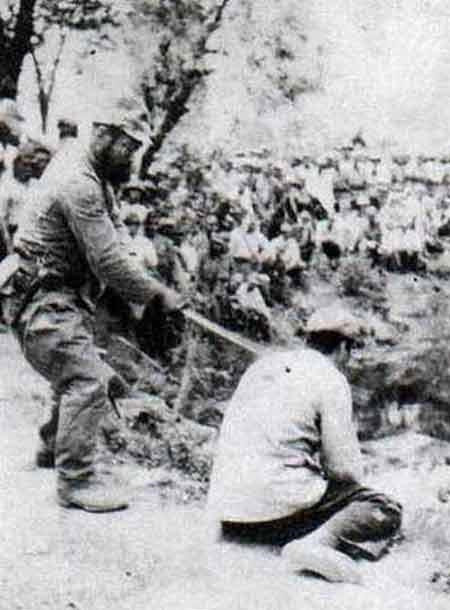
Japan tortured and then executed countless POWs. Speaking of this, a former Japanese Army officer said they did this “for the sake of our country” and for “our filial obligation to our ancestors.” He added, “we never really considered the Chinese humans. When you're winning, the losers look really miserable. We concluded that the Yamato [i.e., Japanese] race was superior.” This was also evident in what they called Americans, who were referred to as “kichiku (mongrel beast or mongrelized apes).”
Parenthetical comment: I'm waging war against this loony “racial superiority” nonsense because this lesson of history is never learned by many people, including modern healthcare professionals who intentionally kill black patients, as I discussed years ago.
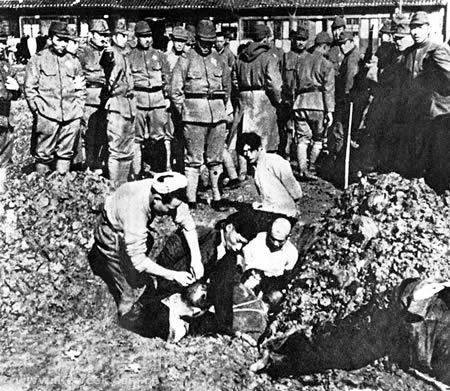
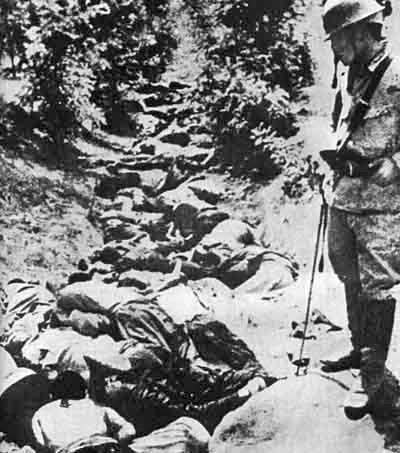
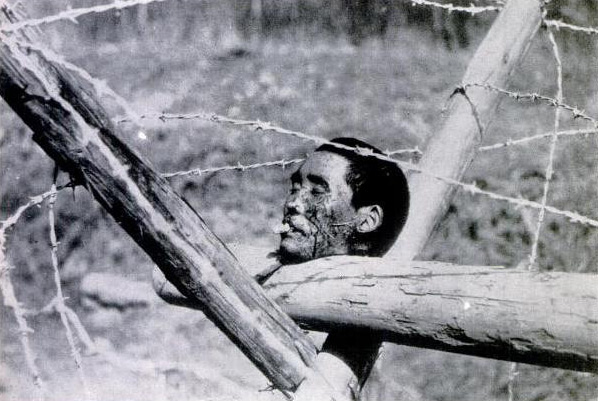
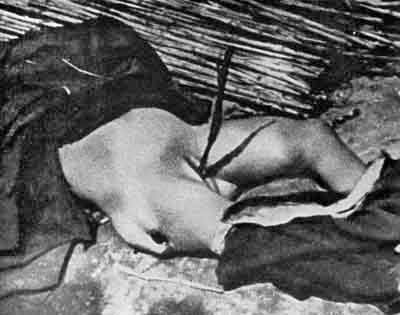
who speared her vagina (read of similar atrocities)
Contrast that treatment with this:
“Four or five little Japanese women came out of the cave, so Marines went up and got them and brought 'em down. We had to cross a stream, and these Marines picked these little women up, in their arms, so they wouldn't have to walk through the water, and carried 'em over. They were thinking of their mothers, their sisters, their daughters.”
— Captain Cyril J. O'Brien, USMC (Ret.) interviewed on War Stories with Oliver North, Episode 36: Assault on the Marianas
“One of our platoons discovered a cave … then they heard a child crying inside, and they went in and found this little girl, probably 2½ or 3 years old, and brought her out of the cave. She was very dirty, and so after we got her cleaned as well as we could, [an endearing picture showed two Marines washing her] … I took a new skivvy shirt that I had in my pack; I put it on her, it came all the way down to her ankles.”
— WWII veteran interviewed on War Stories with Oliver North, Episode 36: Assault on the Marianas
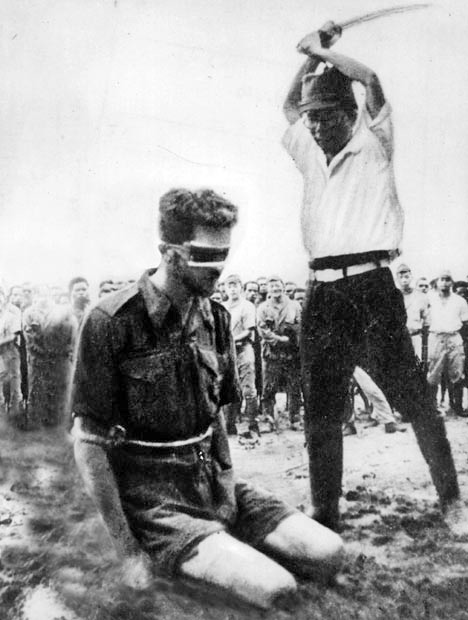
about to be beheaded by a Japanese soldier. The picture below shows him
with his fiancé Clarice Lane about two years before his execution:
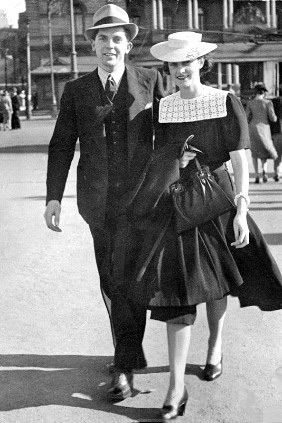
he could have had, and their children, and their children, ad infinitum.
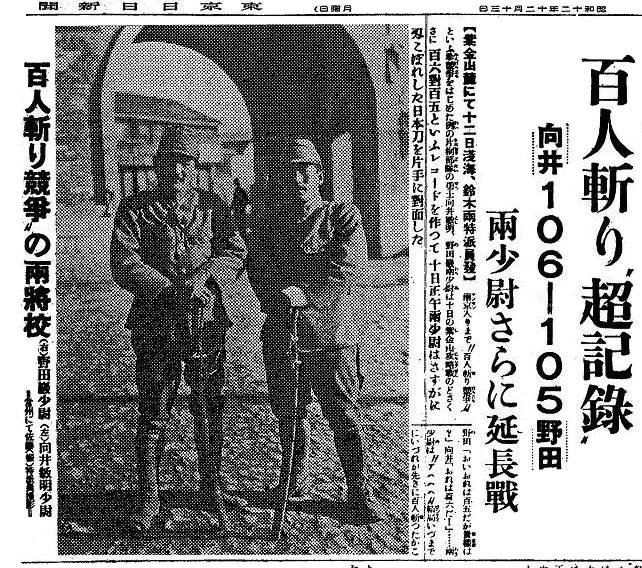
Ghosts of Bataan, a war documentary, presented numerous examples of Japanese war crimes during World War 2, such as running over POWs with tanks, beheading prisoners, and stuffing so many American soldiers into boxcars on a 110-degree day that they begin panting for air, with some dying of asphyxiation. An American POW recalled, “I watched a guy have his arms broken in so many places. They put his arms across saw horses and they beat him across the arms and wouldn't let the doctor reset his arms.” A description and images of this begins at 3:18 in the following video:
Amongst the atrocities listed in a Ken Burns documentary (The War: A Necessary War), Japanese soldiers decapitated Allied POWs, amputated their genitals, and stuffed them in their mouths.
Although Ken Burns (and PBS, which broadcast the program) is as politically correct as they come, the documentary included numerous instances of people saying “Jap” or “Japs,” which I've heard countless times before on other documentaries. (One example: The acclaimed documentary series Crusade in the Pacific included many uses of the word “Jap,” including a public speech by Louis Mountbatten, Supreme Allied Commander of the South East Asia Command, a British statesman and naval officer who was a close relative of the British royal family.) In contrast, after decades of watching television, I can't recall the N-word being used once (certainly not numerous times on one show) because it is considered racist whereas “Jap” is part of history. Treating various patients whose bodies (sometimes including genitals) were mutilated during World War II by Japanese soldiers, none of the veterans referred to them as “Japanese” but instead “Jap” or “Japs.”
Historian Chalmers Johnson wrote that both Germany and Japan “looted the countries they conquered on a monumental scale, though Japan plundered more, over a longer period, than the Nazis.” He added that when Nazis captured prisoners of war from America, Canada, Britain, Australia, or New Zealand, they “faced a 4% chance of not surviving the war” whereas “the death rate for Allied POWs held by the Japanese was nearly 30%.” Unlike Hitler, who paid the ultimate price for his many sins, Emperor Hirohito and his family got off scot-free and lived a carefree life of luxury.
Daniel Inouye, an American of Japanese ancestry and currently a United States Senator from Hawaii, witnessed the attack on Pearl Harbor on December 7th 1941. As the Japanese planes roared overheard, he ran outside and yelled, “Damn Japs!” Was he racist for saying “Japs”? Of course not.
In fact, if I were Japanese, I would welcome any word that separated me from those barbarians. If the word was disparaging, so much the better. Who wouldn't want to disparage human monsters who did such things? Media Matters, that's who.
Media Matters wants you to believe I am racist because I called those savages “Japs,” but that word has been used myriad times on various televised military documentaries, including programs aired in the politically correct 21st century.
Guess who else used “Japs”? Angelo Carusone, President of Media Matters! Related: The Astonishing Hypocrisy of Media Matters.
“How easily someone is offended is directly proportional to how stupid they are.”
— Ziad K. Abdelnour in Economic Warfare: Secrets of Wealth Creation in the Age of Welfare Politics
In my blog posting, it was obvious that I was not referring to all Japanese people or today's Japanese people. The fact that Media Matters would defend such barbarians speaks volumes of their moral compass. If you or a loved one were one of the 580,000 people who died from their germ warfare and human experiments, you'd probably invent a word much harsher than “Japs.”
From a Military Channel special: “The Japanese were brought up in three or four cardinal truths from cradle to grave: that the Emperor was divine, the country was invincible and consisted of [the] chosen race — things like these which were drummed into the Japanese mind from kindergarten up.”
The Japanese indeed thought they were vastly superior to others, whom they considered dirt they could abuse any way they wished. Thinking they were the “chosen race” manifested their ethnocentric racism. The Japanese of that era weren't just racists but outrageously so, in some ways even worse than the barbaric nutballs that did Hitler's dirty work. Thus by siding with the racist Japanese of that era (I never referred to any other Japanese as “Japs,” just the ones who committed crimes against humanity), Media Matters demonstrated they'll get in bed with child-raping and butchering monsters if it is politically expedient for them.
But make no mistake: Media Matters doesn't give a hoot about political correctness unless they can milk it for political purposes. Media Matters did not bash President Obama for laughing at his own joke in which he clearly was amused by how children with physical disabilities can move awkwardly. Had George W. Bush done that, he would have been called sick, twisted, mean, cruel, deranged, disgusting, immature, and evil.
From another documentary: “The desperation to hold off the Allies made its way into the classroom. Thousands of balloons manufactured by Japanese schoolchildren were loaded with incendiary bombs and antipersonnel devices and launched into the Pacific jet stream, which took them straight across to North America. … About 500 made it to the mainland, causing numerous forest fires and several deaths—the only fatalities inflicted on the United States mainland in the entire war.”
I discussed more Japanese war crimes and war atrocities in another article.
“No car with my name on the hood is going to have a Jap engine inside.”
— Henry Ford II
Commenting on this, the Henry Ford II page on the Ford Wiki noted, “This bit of anger was perhaps understandable for a man who had served in the U.S. Navy during World War II …” This meshes with the people and patients I knew who encountered Japanese soldiers during World War II: brimming with resentment at the horror of what they experienced or witnessed. In retrospect, I don't recall comparable anger toward German soldiers, who committed plenty of atrocities, usually against civilians.
“The Japs started this war; we are going to finish it.”
— Frank Knox (William Franklin Knox), Secretary of the Navy and newspaper editor and publisher, in WW II in Color,
Red Sun Rampant (S1 Ep 5; first aired 8-29-2010)
“ … so the Jap Admiral is assuming we were one of [Admiral William ‘Bull’] Halsey's fast carrier groups …”
— WWII veteran interviewed by Lt. Colonel Oliver North on War Stories with Oliver North, Episode 63: The Battle of Leyte Gulf (first aired 10-22-2017)
“They're out to recapture the first bit of American-owned land seized by the Japs: Guam in the Far Pacific.”
— Newsreel announcer on War Stories with Oliver North, Episode 36: Assault on the Marianas (first aired 8-17-2003)
“U.S. SUB WAHOO, FLIES EIGHT JAP FLAGS AND BROOM: Broom Is In Token of Wiping Out of Complete Jap Convoy”
— Newspaper headline shown in a Smithsonian Channel documentary Hell Below: America Fights Back (S1 Ep 1; first aired 7-31-2016)
“BIG JAP NAVY BASE RAIDED”
— Headline from The San Francisco Examiner, pictured in Pacific War in Color, The Enemy Underground (S1 Ep4; first aired 7-15-2018)
“We were in the foxholes, and the Japs ran right over us.”
— Major Edward McCarthy, quoted in Pacific War in Color, The Enemy Underground
“This little Jap came up with that bayonet and went in my arm between the bones.”
— Sgt. Joseph Brown, quoted in Pacific War in Color, The Enemy Underground
“Jap fire is coming down around us.”
— Sgt. Jack Werner, quoted in WWII in HD, Striking Distance (Ep 11; first aired 11-18-09)
A Chicago Tribune article (6-7-1942): Navy Had Word of Jap Plan to Strike at Sea.
I've heard (and will eventually post) countless other quotes, typically from military documentaries interviewing WWII soldiers, also using “Jap.” Considering what Japanese soldiers did, that anyone would defend them or feign outrage at what they're called is as kooky as throwing a conniption fit if comparably pejorative words were directed at child rapists—which, by the way, is one of the horrific crimes committed by Japanese soldiers, who went even further, sometimes mutilating their victims.
JAP is also the obvious acronym/abbreviation for the Journal of Applied Physiology, just as JAMA is that of the Journal of the American Medical Association.
“FRENCH SOLDIER: We were no great friends of the boche.
ANNOUNCER: The boche—pejorative nickname for the German soldiers during the previous war [World War I]. Also named Krauts, Jerrys, Huns, Fritzs, Heinies … they are also called durafour (spelling?), meaning potato peels, parasites …”
— From a Smithsonian Channel documentary Apocalypse: The Second World War, Episode 4 Aggression (first aired 11/11/2009)
Comment: Most of those nicknames are intentionally disparaging—and anyone who wonders why needs a stat brain transplant.
It is human nature to hate and verbally bash America's enemies. Senator John McCain, tortured in North Vietnam, said, “I hate the gooks. I will hate them as long as I live.”
As horrible as McCain's torture was, what Japanese did to innocent civilians was markedly worse.
“Everybody wants to save the Earth; nobody wants to help Mom do the dishes.”
— P. J. O'Rourke
True example of how omitting details blurs the context so much a hero can sound like a scoundrel:
When I was about 8 years old, I was in the middle of a lake when a stranger plucked me out of the water, threw me in his boat, and raced me to his house where he carried me inside, took me into his bathroom where his mother immediately stripped me naked without saying a word. What I reported so far is all true and makes them sound as if they are kidnappers and child molesters.Now let's add context and see how the story changes. I'd fallen through the ice, struggling unsuccessfully to get out when the man, in his late teens or early twenties and dressed in a white T-shirt (no coat), pushed his skiff toward me while running. After pulling me and my dog out (he'd also fallen through the ice) and taking me into his home, his mother removed my clothes soaked with freezing water and put me in a tub of warm water because she was obviously concerned about hypothermia.
Omitting context makes them sound evil, but with context, they sound like intelligent, concerned, and heroic people. The son risked his life to save mine, so they are great folks who deserve an award and recognition. If I become wealthy, I will start a heroism award in their name and generously reward them.
They are truly heroes. The word “hero” is overused, often applied to emergency personnel just doing their jobs. Some people called me a hero for what I did in the ER, but I was just a doc doing my job; I wasn't a hero then; the single heroic thing I recall doing was when I risked my future to save the life of a young black man.
A hero goes above and beyond the call of duty or responsibility and puts his or her life in jeopardy to help a stranger. The man who rescued me repeatedly fell through the ice, but he used his boat to distribute his weight across the thin ice and pushed himself up to keep coming toward me. He could have stayed in his home or looked up the number to the county sheriff (911 service didn't exist then) and called him to fish my body out of the water. Or he could have retreated to safety the first time he fell through the ice, but he didn't. That is a hero.
“Give me six lines written by the most honorable of men, and I will find an excuse in them to hang him.”
— Cardinal Richelieu
Similarly, many people want to play their silly PC game but few want to combat actual racism, as I did years ago in publicizing healthcare professionals who murder black patients. I don't give a hoot about being politically correct in referring to monsters who butcher women and children. They should be verbally lambasted. Anyone who wants to protect them has a screw loose.
Context is everything. Media Matters conveniently ignores context to pull the wool over the eyes of anyone stupid enough to listen to them. I adored my Japanese professor and like a Japanese friend for good reasons. With equal justification, I detest Japanese war criminals for what they did. Race has nothing to do with it.
Considering their relatively small percentage of the world's population, Japan is nevertheless #1 with the greatest number of companies on the list of oldest companies. As someone whose life revolves around innovation, I admire innovative people, companies, and nations, so I revere the Japanese people who contributed so much to the advancement of the world. They of all people should have continued using their brains to get ahead, not reverting to brute force as they did circa World War II. Bashing the monsters who did that is eminently justified, just as no one but nuts gives others a hard time for criticizing Hitler or his Nazis.
President Truman also used the word “Japs”
Beginning at 5:27 in this recording, he said, “The Japs will soon learn some more of the military secrets agreed upon in Berlin. They will learn them firsthand, and they will not like them.”
The bizarrely selective outrage of Media Matters
White House Chief of Staff Rahm Emanuel referred to certain liberal activists as “fucking retarded” (or “fucking retards,” according to other reports). Media Matters defended him, saying “it's worth noting that Emanuel has apologized for the comment at least twice now.”
This illustrates their selective outrage: whether they attack or defend someone is based not on the evidence, but on whether they support or oppose Obama. Hitler's henchmen had a similarly bizarre moral compass; whether they fried you or looked the other way was determined not by what you did, but by whether you supported Hitler.
Second, the world is awash in insincere apologies motivated by a desire to be let off the hook; heartfelt regret for some transgression is relatively rare.
Third, one cannot accurately judge whether some word was intended to disparage a group or just some offensive element within it unless one examines the context of how that word was used. Had Media Matters done that in my case, they would have seen that I was targeting only Japanese war criminals, not Japanese people in general. I attacked monsters who deserved to be attacked.
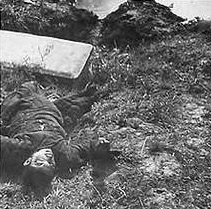
Since Media Matters is impressed by apologies, it is high time I apologized for calling Japanese war criminals “Japs” after they butchered tens of millions of civilians, including children and elderly folks, many of whom were raped and brutalized, such as by being speared through the vagina (see above photo).
In retrospect, I now realize it was unconscionable for me to call such savages “Japs” when I should have used far harsher terminology. Since they referred to American soldiers as “kichiku” (mongrel beast or mongrelized apes), let's think of an appropriate term for them; please submit your suggestions in a comment below. While you're at it, think of an appropriate characterization of Media Matters.
If a Japanese soldier carved pieces from your body, you would surely call him expletives that made “Japs” seem professorial. That's one of the problems: most people are much more concerned with what happens to us than others, especially strangers in faraway lands. Most of the victims can't express their outrage because they are dead and hence permanently silenced. Young girls who were raped and then had spears thrust in their vaginas cannot tell you how God-awful the agony was; indescribably intense and agonizing pain inflicted by extremely cruel and wicked monsters.
Unable to contain their fury, some fathers in court attacked defendants who raped or murdered their daughters. I've never heard anyone so coldhearted they criticized the fathers who went berserk. Instead, our capacity for imaginative sympathy—figuratively putting ourselves in their shoes—makes it easy to understand why fathers would do such things. Many even applaud the retaliation, which is viewed as being pardonable, even desirable.
If someone murdered my daughter (if I had one), he would wish the police put him safely behind bars. If all fathers were similarly intolerant of depredations done to loved ones, rapists and murderers would have compelling reasons to think twice before committing their dastardly acts. The prospect of free food, housing, medical care, and cable TV for life just isn't an adequate deterrent, judging by crime statistics. Very few criminals are so insane they cannot control their behavior; most just do a cold Machiavellian calculation in which they weigh the rewards (to them) of the crime against the possible risk. Computing risk versus reward is something humans do so automatically that we rarely think of it, but almost everything we do includes at least a subconscious assessment of whether that action will bring us more pain or pleasure, harm or benefit, risk or reward.
If we can understand and even excuse taking justice into our own hands, we can understand why it is reasonable for people with normal human emotions—not coldhearted robots—to verbally assail barbarians like the Japanese war criminals.
Arthur H. R. Fairchild said:
“The most distinctive mark of a cultured mind is the ability to take another's point of view; to put one's self in another's place, and see life and its problems from a point of view different from one's own. To be willing to test a new idea; to be able to live on the edge of difference in all matters intellectually; to examine without heat the burning question of the day; to have imaginative sympathy, openness and flexibility of mind, steadiness and poise of feeling, cool calmness of judgment, is to have culture.”
Since imaginative sympathy is one of the hallmarks of cultured minds, cultured people can understand and even congratulate me for lambasting Japanese war criminals. For example, Dr. Michael Brett-Crowther, Editor of the International Journal of Environmental Studies, wrote to me, “I think your remarks on Japan's unadmitted, unrepented guilt are very sound and far better expressed than many on US Veterans' sites.” He requested that I write and submit a paper on the “cultural environment for Jap atrocities” because “the Japanese must confront their responsibilities.”
I agree. Japanese war crimes are hardly ancient history. They are as relevant today as they were in the not-too-distant past when Japanese were doing horrifying things to innocent people, even infants and children. Some of us are too busy with our iPods and whatnot to give a hoot about what happened to them, but cultured people will never forget.
Will you?
There is no expiration date on the relevance of this topic because what Japanese soldiers did before and during World War 2 had its genesis in peculiar ways that humans justify such actions. These tendencies remain latent in most of us, but can be elicited by clever but diabolical leaders such as Hitler, Stalin, Mao Tse-tung (Mao Zedong), and Emperor Hirohito. Those butchers created a veritable torrent of blood during the 20th century that killed well over one hundred million people and made billions suffer. They are hardly alone. Evil still exists in leaders, followers, and those who follow their own rules. We cannot fully extinguish it, but by understanding its roots and tirelessly punishing transgressors, we can minimize it, creating a more just world in the future and giving some measure of justice to past victims who are too often forgotten.
“I believe one of the best ways to achieve justice is to expose injustice.”
— Ziad K. Abdelnour in Economic Warfare: Secrets of Wealth Creation in the Age of Welfare Politics
The recipe for the “cultural environment for Jap atrocities”
Teachers and professors rarely if ever mention the primary take-home lesson: the barbaric Japanese war crimes were a pernicious side effect of individually weak people led by a strong central government. Strong men don't rape and butcher infants, children, women, and grandmothers just because they live in a different country; strong men would defend them. Strong men don't invade neighboring countries, loot them, and blast them to smithereens. Strong men think for themselves, which is why evil governments despise them: they're just too hard to control.
Thus governments that seek to be evil seek to be strong. Less power for the people, more power for them. Less money for the people; more taxes means more money for them. More regulation, more control for them. Less freedom for the people; more freedom for the government to do whatever the hell it wants, beginning with small steps and progressing to ever more dastardly acts.
Ultimately, that's why Media Matters attacked me: because I am strong enough to think for myself. I am not fully Right or Left; I praised Obama when he deserved praise but blasted him for ObamaCare, which is engineered to help teach Americans to acquiesce to a strong central government that wants us to get on our knees and do as we are told, even if it hurts us—and it will, as even staunch Democratic voters will belatedly discover. But Media Matters and others in the far-Left don't want strong people thinking for themselves; they want compliant spineless or brainless weak ones who march in lockstep with their ideas, more than a few of which filter down from one of their donors: the notoriously kooky George Soros who has a gift for leaving misery in his wake.
The rape of Anene Booysen
Anene Booysen was a 17-year-old South African girl who was gang-raped and disemboweled in a manner similar to crimes committed by Japanese soldiers. Quoting from the Wikipedia:
“South Africa's President Jacob Zuma has condemned the attack as "shocking, cruel and most inhumane". The Congress of South African Trade Unions (Cosatu), South Africa's biggest labor union, called for mass action over rape in South Africa. Opposition parliamentary leader Lindiwe Mazibuko called for parliamentary hearings. The United Nations issued a statement strongly condemning the rape and murder.”
I completely agree, but are savage murders any less worthy of condemnation if they happened not yesterday but last week? Or last month? Last year? Last decade? No, so we should never forget about the many Asian and other victims of Japanese brutality.
Verbally disparaging evil people is normal
One of the unwritten laws of civilization is that it is not acceptable to verbally lambaste people who don't deserve it, but it is OK and perfectly understandable to blast with both barrels those who do evil things. I've heard Hitler called every name in the book, but I've never heard anyone loony enough to complain that Hitler didn't richly deserve being verbally battered. Neither the world's best writers nor the most profane sailors could possibly think of terms for Hitler that are even 1% as offensive as what he did.
Similarly, I am sickened by what Japanese war criminals did to people in China and other Asian nations before and during World War II. Just as we should never forget the Holocaust, we should never forget that evil. If young people today aren't livid about those wrongs, they are one step closer to becoming a generation that tolerates them or even participates in them.
Is this just an academic exercise? Hardly! This article is one piece of the puzzle. In other articles, I presented evidence that the United States recently committed war crimes that many people cannot see because they are blinded by nationalism and likely more than a tinge of racism.
Moreover, the verbal disparagement doesn't end after the war. Who in their right mind protects Hitler by attacking those who call him unflattering names? There's no path to redemption for someone that evil. Hitler richly deserves to be lambasted forever, not just until 1945. Japanese soldiers, sailors, and airmen circa World War II committed more and arguably even worse war crimes, thus they also deserve eternal condemnation.
Not wanting to lump all Japanese in with the bad ones, I thought it was preferable to differentiate between the two by calling the evil ones “Japs.” Since they committed acts more numerous and often more depraved than what nutjob Hitler did, they're fair game for verbally blasting.
“You help the moderate Muslims when you call out the radical Muslims; when you pretend like there aren't radical Muslims, then they all get lumped together—you're actually discriminating.”
— Pete Hegseth
Comment: Exactly. This also applies to differentiating good from evil Japanese. If American soldiers committed equivalent atrocities, it would be best to label them with a different name (preferably a disparaging one) so they weren't lumped with good Americans.
To see how people accept verbally knocking evil monsters, consider how no one complained about what a mother said after a teenager allegedly trying to murder a rival gang member instead fatally shot her 6-year-old daughter. She said, “They're not teenagers. Real people with a real heart don't do this, so I'm sorry, they're not teenagers. They're not people—they're animals. They're garbage.”
On January 16, 2015, CNN's Alisyn Camerota asked a great question:
“When the Westboro Baptist Church does something odious at a fallen military man's funeral, because they hate homosexuals, no one asks real Baptists or real Christians to apologize for that. Everyone recognizes that they are a separate, extreme, strange group. Is it time to have a different word, rather than ‘Muslim extremist’ or rather than ‘Islamic radicals’—a different word for this other cancerous group that's doing these thing?”
Excellent point. Whenever different words could be used to differentiate groups, it is better to make the distinction than to lump them all in together. Consequently, calling the savage Japanese war criminals “Japs” spares the good Japanese the taint of what the monsters did.
Media Matters is so notorious for their untenable, over-the-top claims that even liberal Democrats are bashing them. For example, the über-liberal New York Times called Media Matters “highly partisan,” and Harvard Law Professor Alan Dershowitz, who describes himself as a liberal Democrat, declared war on Media Matters, saying they have “crossed the line” and use Hitler-like tactics. Professor Dershowitz said he “can't tolerate bigotry on any side of the political spectrum.”
bigot (noun): (1) a person who is utterly intolerant of any differing opinion, belief, or creed; (2) a person who is obstinately intolerant of any ideas other than his or her own, especially on politics or religion, and has animosity toward those of differing beliefs.
Dershowitz said the Media Matters smear merchant used “virulent hate speech” and an odious, “wildly inaccurate” canard:
canard (noun): a fabricated sensational statement or report, especially one set afloat in the media to hoax the public; an absurd, unfounded, false, baseless, or extravagant report, rumor, hoax, or story that is deliberately misleading and usually derogatory; a false report motivated by maliciousness that is intended to deceive people; a fable, fiction, or falsehood; a lie.
Dana Loesch wrote that Media Matters “has been an embarrassment with pettiness and hyperbole permeating every post. Their baseless attacks on political enemies they wish to blacklist has earned them the reputation as modern-day book burners. Their mission of correcting "conservative misinformation" has been refuted countless times by numerous outlets.”
There appears to be no limit as to how low Media Matters will go in attacking people they perceive to be their political enemies. For an example of this, consider how they criticized me for creating a free website that helps people quickly and permanently end their spam problems.
Even semi-credible news organizations try to get their facts straight before opening their mouths. Media Matters purports to be a fact-checking organization, so one might think they would be even more concerned with accuracy, but they're more reckless than most beginning journalism students. For evidence of this, consider how they attacked me for taking what they presumed to be an extreme Right-wing opinion when in reality on that issue, I am further Left than most folks in the far Left. However, the sages at Media Matters painted a picture of me as being further Right than Attila the Hun. Thus if you don't believe Bill O'Reilly when he complains of outrageous smears by Media Matters, believe me. Or judge for yourself.
I don't fall for the phony Left-Right paradigm. I agree with liberals on some issues and conservatives on others, but I don't side with the Left or the Right or give them my allegiance. Both sides have an agenda that often compels them to distort the truth. Our leaders give lip service to “healing” and “bringing us together,” but almost everything they say is divisive, intended to drive a wedge between us and fuel the hate that is rampant in America, with people often walking around with chips on their shoulders, looking for flimsy reasons to hate others. Our politicians stir the pot so they can divide and conquer. Leaders should set the benchmark for statesmanship and cooperation, but ours just want endless turmoil they milk for their Machiavellian schemes to stay in power despite their pathetic ideas. Year after year, the sheeple fall for this transparent ploy.
With the world economy on the verge of a meltdown and with evil far from extinguished, and with our leaders unwilling or unable to solve those problems, giving allegiance to those nitwits or the partisans who support them strikes me as a waste of time.
In fairness to Media Matters, they're not the only ones who slant reality to favor their side. For example, how many Fox News viewers know that a recent occupant of the White House is a killer?
List of major Japanese war crime incidents:
- Alexandra Hospital massacre
- Banka Island massacre
- Changjiao massacre
- Kalagong massacre
- Laha massacre
- Manila massacre
- Nanking Massacre
- Palawan Massacre
- Parit Sulong Massacre
- Sook Ching massacre
- Tol Plantation massacre
- Wake Island massacre
- Panjiayu tragedy
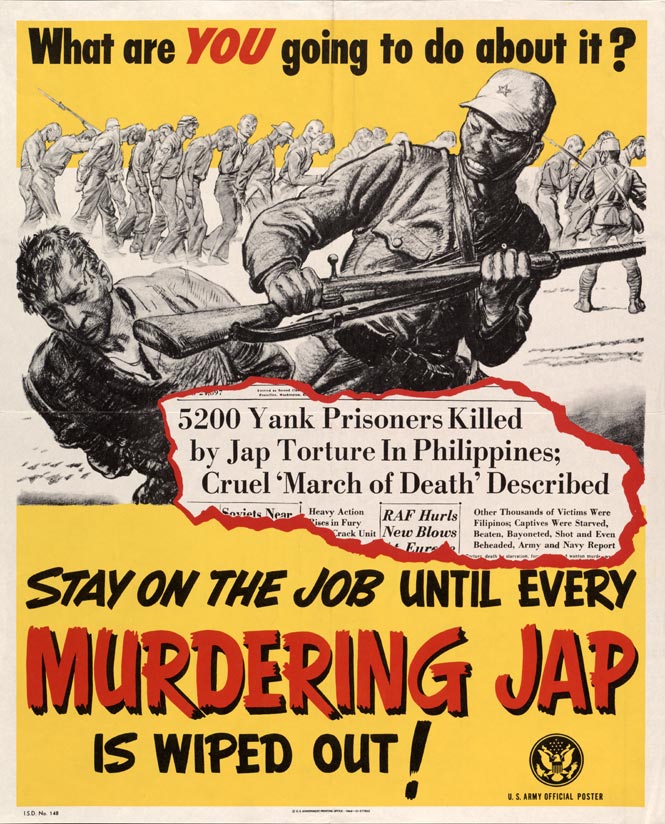
- Bataan Death March (see above STAY ON THE JOB poster from the U.S. government)
- Sandakan Death Marches
- Hell ships
- Three Alls Policy
- Kaimingjie germ weapon attack
- Changteh chemical weapon attack
- War crimes in Manchukuo
- Japanese occupation of the Andaman Islands
- Balalae Island
- Burma Railway
- Comfort women (Related: How Do the Japanese Teach About WWII? Discusses enslavement as laborers, forced prostitution, and sex slaves euphemized as “comfort women.”)
- Unit 100
- Unit 200
- Unit 516
- Unit 543
- Unit 731
- Unit 773
- Unit 1644
- Unit 1855
- Unit 2646
- Unit 8604
- Unit 9420
Notes:
- I documented similar war crimes committed by Soviet soldiers during World War 2 in another shocking article.
- The Politically Incorrect Guide
- Video: WWII Marine Talks About How Evil the Japanese Were
Comment: A WWII veteran displays a photo he took from a Japanese soldier showing other Japanese soldiers in China who cut off Chinese heads and collected them in a cage.
Something (important) to think about:
- Japan and its people were hated by most Americans during World War 2, and they hated us: hence the “kichiku” (mongrel beast or mongrelized apes) epithet. However, consider this: Japan is now one of our closest allies, and we're very fond of its citizens, whom we almost universally hold in high regard, and they generally reciprocate the affection. What triggered that relatively rapid shift of opinion? Are there any lessons here that could help us improve relations with Muslims? (Hint: I've previously written about this topic.)
- Why were Japanese soldiers so cruel? In a war documentary, Ghosts of Bataan, a Japanese soldier explained:
The recipe for creating a mean dog (beat or otherwise mistreat it) is no mystery, so the explanation of that Japanese solider makes sense. However, it does not explain all Jap savagery. For example, why did they rape Chinese women and children? Rape was not an acceptable part of the Japanese culture in Japan, so Japanese soldiers stationed there did not rape Japanese women or kids, but in China, they raped and killed as if their victims were inconsequential dirt or “the lowest form of life,” as the Japanese soldier quoted above might say. This represents the ultimate form of prejudice: to think so little of others outside one's group that one is eager to treat them worse than animals.“The Japanese soldier himself was not treated as a human being, but as a tool of the Emperor. In the Navy, we had our backsides beaten with a baseball bat, and faces beaten. The Japanese soldiers and sailors were not treated with respect as human beings, so how could they be expected to respect the POWs or treat them differently? The Japanese military taught men that violence was the way to impress one's will. The enlisted men in turn vented their aggression against the POWs. The POWs were looked at as the lowest form of life, and could be dealt with as one pleased.”
- Many people still try to shame the United States for dropping two atom bombs on Japan, but how many people still try to shame Japan for killing and brutalizing considerably more people? If history should never forget what the USA did, we should also never forget what Japan did, which was considerably worse—unless you think it was not acceptable to have stopped Japan from invading innocent countries, killing innocent people by the millions, raping everyone to young children to grandmothers, and sexually (and otherwise) mutilating many of the victims. And on and on.
From a television documentary:NARRATOR: The military supervisor of Japan's [atomic] bomb project went to examine the ruined cities [Hiroshima and Nagasaki] firsthand.
SUPERVISOR (Tatsusaburo Suzuki, retired Japanese Army officer): I flew over Hiroshima and Nagasaki at low altitude and saw that the results were devastating. … I saw that this weapon was horrible … it was cruel to use it against cities [and their civilians].
Yes, it was, but it was also cruel for Japan to have committed millions of prior war crimes against cities and civilians that compelled American leaders to stop the savage Japanese aggression and perverted code of bushido that made them think it was acceptable to brutally treat people, including civilians, in other nations. A classic double standard.
Suzuki added, “The first thing I thought of was that we had to strike back fast. … I wanted us to have such a weapon [atomic bomb] ready as soon as possible.”
Considering Japan's history of treating civilians worse than dogs, if they had the chance to use atomic weapons against U.S. civilians, they likely would have done that. For proof, consider how (as I mentioned above) Japanese schoolchildren made thousands of balloons intended to kill civilians in the United States.
Related articles:
- I presented more shocking war crimes in another article: Hirohito: the war criminal who got off scot-free
- Why I discussed Japanese war crimes
- Regarding oldest companies: Most Iconic Restaurant Chains That No Longer Exist
- Brilliant master's thesis by Jay Fagel: Japanese Army Brutality During The Asian-Pacific War
- Book: An Inconvenient History: Japan's Dark Shadow on Asia
- Video: Newsreel: Major Boyington Is Found Alive (1945)
Comment: The legendary WWII fighter ace Gregory “Pappy” Boyington describes some of the utterly senseless Japanese torture of American POWs.
“The test of a first-rate intelligence is the ability to hold two opposed ideas in mind at the same time and still retain the ability to function.”
— F. Scott Fitzgerald
Reference: Imagining dialogue can boost critical thinking: Excerpt: “Examining an issue as a debate or dialogue between two sides helps people apply deeper, more sophisticated reasoning …”
Comments (2)
 Post a comment or subscribe to my blog
Comment #192 by Anonymous
December 30 2011 12:54:49 PM
Now I understand why my wife's late grandfather, who fought on Iwo Jima and Okinawa, never said the word "Jap," it was always "Jap bastard." I also now understand his reaction when I bought my first new car in the late 70s, a Datsun.
Comment #346 by Not a racist or bigot--just the messenger
Contact the commenter via MySpamSponge: therapist
July 31 2014 10:48:11 PM
Just sayin'
I previously had a boyfriend who was half Japanese but fully steeped in the Japanese culture. The rules were that only HE could make jokes about Japanese behavioral idiosyncrasies. It was not acceptable for me to make any observations. Only HE could make bigoted and disparaging comments regarding people of Polish or African-American descent because he felt he was the superior race. He went further to make comments about anyone and everyone who he felt was imperfect. He LOVED to laugh at people — find anything they ever did wrong, anything about them that wasn't perfect (even things they couldn't control, such as facial features) and mock them for that.
REPLY FROM KEVIN PEZZI: As I mentioned in the UPDATE at the top of this article, I had a very favorable impression of Japanese people (except their war criminals, of course) and their culture, which I assumed was the epitome of courtesy. However, based on what you and James Dyson wrote, that impression seems unduly positive.