


Why am I selling my Sea-doo, Ski-doo, and shed to help a deported person reenter the U.S.?

I am selling my Sea-doo to raise money for Operation Save Liz to help Liz Larios and her husband, Russell Horn. The Northern Express published two superb articles on them (Nightmare at the border: Liz Larios and Deported) that highlighted their plight, courtesy of our federal government that justifies such actions by conveniently forgetting how our nation acquired much of the western United States.
I previously agreed with the millions of Americans who possess a deceptively simple conception of the issue of illegal immigration: it's our country, they entered illegally, kick 'em out, end of story. Then I learned that a huge chunk of the western United States once was part of Mexico. We bought a small part of that land fair and square, but the rest was acquired using might makes right principles of coercion. As fond as I am of the U.S., I am even more fond of doing the right thing, and might makes right is never a justifiable part of that equation.
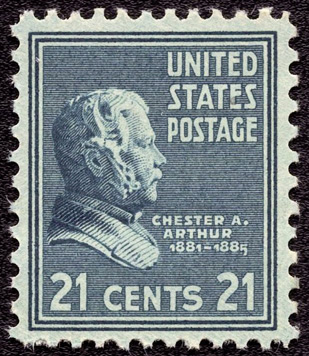
I also advocate treating everyone with decency and respect. If you read the first Northern Express article referenced above, you will likely be shocked by the brutally cold, callous, inhumane, and unprofessional way that Liz was treated by an ICE agent. One of my relatives, Chester Alan Arthur, was President of the United States from 1881 to 1885. If he were President now, that ICE agent would be fired. Arthur was raised in an abolitionist home (his father cofounded the New York Anti-Slavery Society) and later practiced law in New York, where he ably and commendably defended the civil rights of slaves. From the Wikipedia:
“A champion of civil rights, Arthur was one of the attorneys who successfully represented Elizabeth Jennings Graham; her lawsuit, after being denied seating on a streetcar due to her race, contributed to the desegregation of New York City public transportation. In Lemmon v. New York, the "Lemmon Slave Case", Arthur helped secure the 1860 decision that slaves being transferred to a slave state through New York would be emancipated.”
More from the Wikipedia:
“Arthur's primary achievement was the passage of the Pendleton Civil Service Reform Act. The passage of this legislation earned Arthur the moniker "The Father of Civil Service" and a favorable reputation among historians. Publisher Alexander K. McClure wrote, "No man ever entered the Presidency so profoundly and widely distrusted, and no one ever retired ... more generally respected." Author Mark Twain, deeply cynical about politicians, conceded, "It would be hard indeed to better President Arthur's administration." Historically, Arthur was known as the "forgotten" President; who was never fully admired, loved, or feared. As President, however, Arthur transcended the office by promoting the general good over partisan politics.”
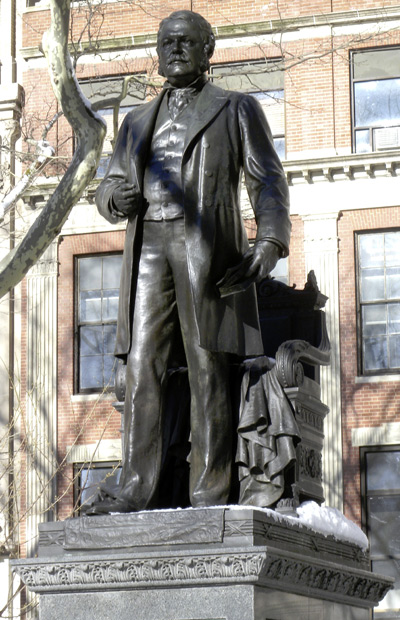
Madison Square in New York City
Arthur made a boatload of money as Collector of the Port of New York—in fact, more than he later made as President. He once firmly believed in and profited from the spoils system, but he “was able to overcome his own physical and emotional demands of the Presidency and without partisanship look after the country's welfare. This was refreshingly surprising since most of Arthur's political career had depended on the spoils system. Although Arthur was a man of his times, he was able to transcend the Presidency by advocating the nation's welfare over party politics. [...] By standing up to his own friend Roscoe Conkling and wing of the Republican Party, Arthur showed remarkable independence from political forces.” (source)
President Arthur was clearly committed to doing the right thing, so he would certainly fire the ICE agent who abused Liz. President Obama should fire him or at least demand that he apologize to Liz.
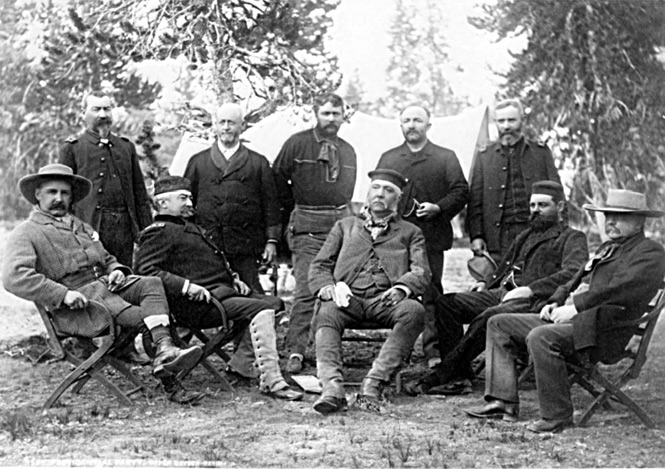
Presidential party in Upper Geyser Basin: President Arthur on expedition in Yellowstone National Park in 1883 with Lt. Gen. Philip Sheridan and Secretary of War Robert Todd Lincoln, son of President Abraham Lincoln. This two-week visit made him “the first President to visit America's first national park.” Arthur's official photographer, F.J. Haynes, later “became the national park's primary photographer and published a book titled Haynes Practical Guide to Yellowstone Park.”
General Sheridan and Secretary Lincoln were pallbearers at Arthur's funeral, along with Charles Lewis Tiffany, founder of Tiffany & Co., and Cornelius Vanderbilt, “patriarch of the Vanderbilt family and one of the richest Americans in history.” One estimate pegged his wealth at $143 billion in 2007 dollars, making him as rich as Bill Gates, Warren Buffett, Sergey Brin (Google), Steve Jobs (Apple), and Prince Alwaleed Bin Talal of Saudi Arabia combined!
I am committed to helping reverse an iniquity, so I am selling my Sea-doo to help Liz return to the United States, where she belongs. I don't know Liz, her husband, or other family, but she strikes me as a good person who led an exemplary life in Traverse City. She held down two jobs, had “a great little home,” a dog, and a loving fiancé who is now her husband. She was—and will be—a blessing, not a burden.
Shortly after I decided to help Liz by selling my Sea-doo, I thought of another possible way to contribute. A movie director asked me to appear in a film discussing some of my unusual ER cases. I responded by saying that I would agree to it only if that producer/director used his Hollywood connections to quickly help Liz and others like her. In his initial message, he tried to entice me by saying that the exposure of appearing in his film would increase my book sales. Perhaps, but not by much, now that so few people have the intellectual stamina to read a book, let alone one with polysyllabic words and concepts that mystify some physicians, such as competitive inhibition of hormones. So, to sell a few more books, I'm going to hop onto a commercial jet and head to California? No way! However, I'd do it to help Liz, who is currently in Juárez, a town where everyone—including the police—live in mortal fear of criminals.
My goal is to save Liz's life. Over the years, I've corresponded with thousands of people, many of whom aspired to become physicians. Some of those people mentioned how great it must feel to save a life—something that few people have a chance to do, but I did every day working as an ER doctor. Some people called me a hero, but as much as I appreciate that approbation, I was just doing my job. A real hero goes out of his way to save someone's life; in the process of doing that, he often is subjected to some peril. Heroic or not, saving lives is immensely satisfying, but you don't need an MD after your name to help save a life; anyone can contribute to Operation Save Liz.


My Sea-doo

To help Operation Save Liz, I will also sell my newest snowmobile (pictured above) and lighthouse shed, which took me 7 months to build. I am as meticulous building sheds or other stuff as I am doing surgery, so my sheds are works of art. My lighthouse shed was featured in a book, Shedworking: The Alternative Workplace Revolution, by Alex Johnson. Alex wanted to also include my Alpine shed, but a computer snafu likely nixed that plan. However, the Alpine shed is mentioned on his website and pictured below:



Here is my schoolhouse shed:

Here's the lighthouse shed I designed and built, and the one I am selling for Operation Save Liz:

For those of us who love lighthouses, looking at a lighthouse shed is enjoyable, and it is fun to ascend into the lantern room (the glassed-in housing near the top) and see for miles. It is even more fun to ride a Sea-doo or Ski-doo, but I contend that helping others, such as Liz, is even more gratifying and capable of eliciting a satisfaction far more enduring than the ephemeral thrill of riding personal watercraft (usually called Jet Skis) or snowmobiles.
Interesting trivia about President Arthur
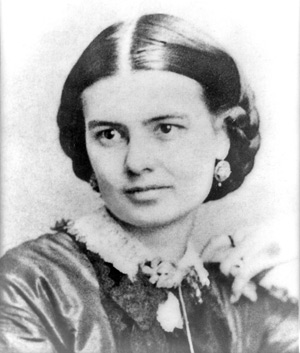
Chester's love for her reminds
me of the song, A Daisy A Day
Arthur was part Native American (thus making me part Native American, since I share some of his DNA) and an exceedingly principled man of his word. He married Ellen “Nell” Lewis Herndon, who died of pneumonia before he became President. “Arthur stated that he would never remarry and … had a memorial to his beloved “Nell”—a stained glass window—installed in St. John's Episcopal Church within view of his [White House] office and had the church light it at night so he could look at it. The memorial remains to this day. [...] By the end of his presidency, Arthur had acquired wide personal popularity. On the day he left office, four young women (ignorant of Arthur's pledge not to marry again) offered to marry him. (source)”
From the Wikipedia:
- Arthur “"moved decisively to curb corruption and incompetency within the Navy." In addition, both the Naval War College and the Office of Naval Intelligence was created. For these achievements Arthur was called the "Father of the Steel Navy."”
- “President Arthur overturned a court-martial ruling against African American West Point Cadet Johnson Whittaker.” (One of the unique joys of being President is having the power to do the right thing by righting wrongs.)
- “In 1884, the International Meridian Conference was held in Washington, D.C. at President Arthur's behest. This established the Greenwich Meridian and international standardized time, both in use today.”
- “President Arthur was also in office when the United States became the first Western country to establish diplomatic relations in modern times with Korea.”
- “Professor Marina Margaret Heiss at the University of Virginia lists Arthur as an example of an INTJ (introversion, intuition, thinking, judgment) personality.”
- “As President, Arthur alleviated his stress by taking late evening walks that usually began after 1 am. He rarely went to bed before 2 am.”
- Arthur “tried to lower tariff rates so the government would not be embarrassed by annual surpluses of revenue.” (Wouldn't we just love to have that problem now? :-)
Many Presidents could benefit by echoing one of Arthur's statements: “I may be President of the United States, but my private life is nobody's damned business.”
Update on DACA
The most basic foundation of justice is that individuals are punished for what they did, not what their parents or others did. Thus, DACA has a strong moral and legal justification. What is the crime committed by children brought into the United States by their parents? Obeying them? Furthermore, our nation lacks the resources to deport all or most illegal immigrants, which necessitates prioritizing deportation. If only some are expelled, it makes no sense to target ones who committed no crime.
Related articles
Liz Horn's Life in Mexico: Now married, she and husband Russell Horn fight to return to U.S.
Obama's commendable Executive Order on Immigration
Notes:
- Psychologists Say 'Group Narcissism' Linked to Negative Attitudes Toward Immigrants
- 'Big Givers' Get Punished for Being Nonconformists
- Investing in Karma by Doing Good Deeds
- The More Gray Matter You Have, the More Altruistic You Are and Individual Differences in Altruism Explained by Brain Region Involved in Empathy based on Linking Brain Structure and Activation in Temporoparietal Junction to Explain the Neurobiology of Human Altruism
- Empathy often avoided because of mental effort
- Agreeable personalities are more likely to help strangers
- For the first time, a neural link between altruism and empathy toward strangers: Using fMRI scans of a brain region called the anterior insula, University of Pennsylvania and Georgetown University researchers discovered that people who donated a kidney to an anonymous recipient were more sensitive to a stranger's fear and pain
- Awe may promote altruistic behavior
- Altruism can be trained
- The warm glow of kindness is real -- Sussex study confirms: The 'warm glow' of kindness is real -- even when there's nothing in it for you
- Oh, brother! Having a sibling makes boys selfless, study suggests
- It Actually Is Better (and Healthier) to Give Than to Receive, Study Finds
Excerpt: “A five-year study by researchers at three universities has established that providing tangible assistance to others protects our health and lengthens our lives.” - Teenage boys who show empathy attract 1.8 more girlfriends than boys who don't: Landmark study shows the extent that teen males and females select empathic classmates as friends
- The secret of empathy: Stress from the presence of strangers prevents empathy, in both mice and humans
- theatlantic.com: Empathy: Overrated?: Be kind, show understanding, do good—but, some scientists say, don’t try to feel others’ pain.
- Maternal depression across the first years of life impacts children’s neural basis of empathy
- When Your Body Needs Calories, You Are More Inclined to Help the Poor
- Pacifiers May Stunt Boys’ Emotional Development
Excerpt: “College-age men whose parents reported they had relied on pacifiers scored lower on tests measuring empathy and the ability to evaluate the moods of others.” - Interest in Arts Predicts Social Responsibility
Excerpt: “If you sing, dance, draw, or act … you probably have an altruistic streak.” - Why parents should teach their kids to give
- Thinking About Giving, Not Receiving, Motivates People to Help Others based on Beneficiary or Benefactor: Are People More Prosocial When They Reflect on Receiving or Giving?
- Compassion Meditation May Boost Neural Basis of Empathy, Study Finds based on Compassion meditation enhances empathic accuracy and related neural activity
- Empathy Represses Analytic Thought, and Vice Versa: Brain Physiology Limits Simultaneous Use of Both Networks based on fMRI reveals reciprocal inhibition between social and physical cognitive domains
- Ability To Literally Imagine Oneself In Another's Shoes May Be Tied To Empathy
- 'Walking a mile in their shoes' may be hazardous to your health: Researcher says how we arrive at empathy is as important as being empathetic
- Can fiction stories make us more empathetic?
- Training brain patterns of empathy using functional brain imaging
- Area of the Brain That Processes Empathy Identified based on Anterior insular cortex is necessary for empathetic pain perception
- Empathy Varies by Age and Gender: Women in Their 50s Are Tops based on Empathic Concern and Perspective Taking: Linear and Quadratic Effects of Age Across the Adult Life Span
- Human Brains Are Hardwired for Empathy, Friendship
- People Have More Empathy for Battered Dogs Than Human Adult, but Not Child, Victims
- Anti-anxiety medication limits empathetic behavior in rats
- Compassion Meditation Changes The Brain based on Regulation of the Neural Circuitry of Emotion by Compassion Meditation: Effects of Meditative Expertise
- Being Naughty or Nice May Boost Willpower, Physical Endurance
- Lost Letter Experiment Suggests Wealthy London Neighborhoods Are 'More Altruistic' based on Lost Letter Measure of Variation in Altruistic Behaviour in 20 Neighborhoods
- Humans Are Happier When They Do the Right Thing; It Also Helps Them Overcome Difficulties
- Generous people live happier lives
- The Surprising Science of How To Be Happy By Spending Money
Excerpt: “Studies show that when you give, whether you give randomly to a stranger or donating to a charity, it boosts both your happiness and your feeling of wealth.” - Tears and fears: How do emotions change our political attitudes?
- Those Genetically Predisposed to Anxiousness May Be Less Likely to Volunteer, Help Others
- We're in This Together: A Pathbreaking Investigation Into the Evolution of Cooperative Behavior
- Lies My Teacher Told Me: Everything Your American History Textbook Got Wrong
- Marco Rubio says some conservatives “harsh and intolerable” on immigration
- White House to halt deportation of young illegal immigrants
Comment: Finally! This should be made retroactive so people like Liz can quickly reenter the United States. - Miami Valedictorian Could Be Deported
- Mother of 19-year-old killed by Border Patrol sues
- Most American presidents destined to fade from nation's memory, study suggests
- Does social status affect generosity?
Excerpt: “ … people with high social status who didn't believe they earned that status were much more generous than high-status people who felt they deserved the respect and admiration of others. Prominent people who don't feel their status is fair and equitable become more generous with others to alleviate that sense of inequity …” - The kindness paradox: Why be generous?: Humans are one of the rare animals to be altruistic. An ancient form of giving holds secrets about why we help one another without any promise of reward
- America ranks in top 10 in empathy
Excerpt: “While a top 10 finish [#7] isn't bad, the lead author of the study notes that the psychological states of Americans have been changing in recent decades -- leading to a larger focus on the individual and less on others.” - ICE detains Polish doctor and green-card holder in Michigan who has lived in the U.S. for nearly 40 years
Comment: The doc isn't perfect but deporting him strikes me as a much greater crime.
“The test of a first-rate intelligence is the ability to hold two opposed ideas in mind at the same time and still retain the ability to function.”
— F. Scott Fitzgerald
Reference: Imagining dialogue can boost critical thinking: Excerpt: “Examining an issue as a debate or dialogue between two sides helps people apply deeper, more sophisticated reasoning …”
Comments (2)
 Post a comment or subscribe to my blog
Comment #171 by Jessica Schmidt
Contact the commenter via MySpamSponge: schmidty 
July 17 2011 02:08:18 PM
Wow, Dr. Pezzi! That is very sad what happened to Liz. Very unfair too! It is very nice of you to sell your jet ski and shed to help her reenter the US.
Trust me, if I had the money I would quickly snatch up that purrty Sea-doo of yours! :D
By the way, love your ad on Craigslist. The part about the squirrel made me laugh!
You are a good man, Dr. Pezzi! Take care!
REPLY FROM KEVIN PEZZI: Hi Jessica! It's great to hear from you again.
If I become rich, I'll buy a jet ski for you. How about that? :-)
Want to hear a cute, true Sea-doo story? While giving a 5-year-old a ride on my Sea-Doo, she sternly warned me, “If anything happens to me while I'm on this thing, my parents will sue you!” How rude! Referring to a Sea-Doo as “this thing”!
Oddly, Little Miss Litigation uttered her threat while I was piloting the Sea-Doo at an unconscionably reckless 3 m.p.h. At that speed, her greatest danger was dying from boredom. :-)
Comment #355 by Elizabeth
August 14 2015 08:07:54 PM
Dr. Kevin Pezzi
I have no words to describe how this article/blog made my day — what a beautiful person you must be! Some days are harder than others and today was one of those days where I just close my eyes and picture myself back on the beautiful shores of Lake Michigan. Thank you for all your kind words and information you have provided readers with.
Sincerely,
Liz Horn (Larios)